Mission Magnum pumps are commonly used where industrial processes require continuous transfer of drilling fluids, abrasive slurries, sand-containing liquids or other demanding process media. Typical applications include drilling mud circulation, solids-control equipment feeding, mud mixing, quarry slurry transfer, mining and mineral processing, sand handling, charge-pump service and general industrial fluid transfer.
However, the phrase "Mission Magnum pump application" covers very different operating conditions. A pump handling drilling mud on an oilfield does not face exactly the same requirements as one transferring quarry slurry or feeding a mixing system. Understanding the actual application is therefore one of the first steps when selecting a pump size, material, seal arrangement and drive configuration.
Industrial centrifugal pumps often need to handle more than clean water. The liquid may contain suspended solids, sand, drilling additives, minerals or other particles. It may also have higher viscosity, greater density or abrasive characteristics that increase wear on hydraulic components. Mission-style centrifugal pumps are commonly selected for these demanding applications because their hydraulic and mechanical configuration can be adapted to different operating conditions.
Depending on the application, engineers may need to consider:
Flow rate
Total dynamic head
Slurry density
Solids concentration
Particle size
Fluid viscosity
Abrasiveness
Corrosiveness
Operating temperature
Suction conditions
Required pump speed
Seal arrangement
Wet-end material
Drive method
This is why the same basic pump family can appear in oilfields, drilling rigs, mining plants, quarries and industrial processing systems. The application defines the configuration.
One of the most recognizable Mission Magnum pump applications is drilling-fluid handling.
During drilling operations, drilling mud must move through different parts of the surface mud system. Centrifugal pumps may be used to circulate, transfer or feed drilling fluid between tanks and process equipment.
Drilling mud is more demanding than ordinary water because it may contain weighting agents, drilled solids and other additives.
Important considerations include:
Drilling fluids can have a significantly higher density than water. Higher density increases the power required to move the fluid.
Mud viscosity affects hydraulic performance and system resistance. A pump should therefore be evaluated using actual drilling-fluid conditions rather than clean-water flow requirements alone.
Suspended solids can increase wear on the casing, impeller, seal area and other wet-end components.
Many drilling-fluid systems operate for long periods, making reliability and maintenance accessibility important.
For relatively high-volume drilling mud transfer, an 8x6x14 Mission Magnum Pump can be considered when its hydraulic range matches the required duty. The final selection should still be based on the actual flow, head, mud properties and installation conditions rather than model size alone.
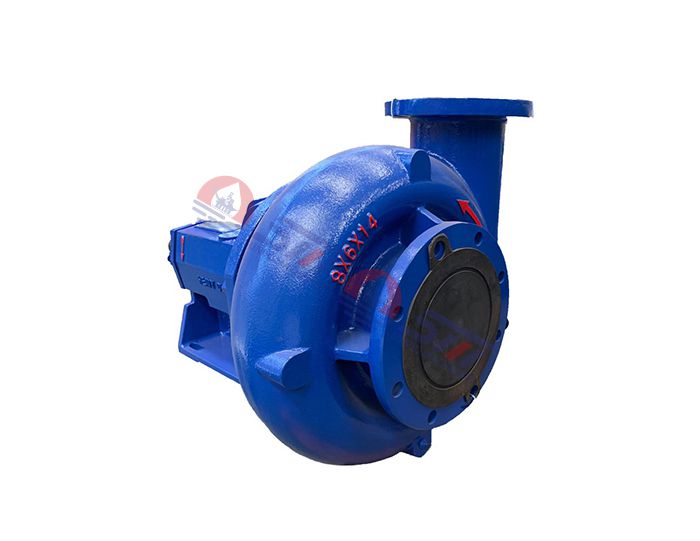
Mission-type centrifugal pumps can also be used as feed pumps in drilling-fluid solids-control systems. Solids-control equipment separates unwanted drilled solids from reusable drilling fluid. Depending on the system configuration, centrifugal pumps may feed equipment such as desanders, desilters or other treatment units.
This application creates a different requirement from simple tank-to-tank transfer. The pump must provide enough flow and pressure for downstream equipment to operate under the intended conditions. If the feed pressure is too low, separation equipment may not perform as expected. If the pump is significantly oversized, excessive flow or pressure can create unnecessary energy consumption and operating problems.
When evaluating a pump for solids-control feeding, engineers should therefore confirm:
| Factor | Why It Matters |
|---|---|
| Required equipment feed rate | Determines flow requirement |
| Required inlet pressure | Influences pump head |
| Mud density | Affects power |
| Solids concentration | Influences wear |
| Suction tank level | Affects inlet conditions |
| Pipe diameter and length | Influences system resistance |
| Continuous duty hours | Influences reliability requirements |
Instead of selecting the pump only according to flange size, it is better to evaluate the complete solids-control process.
Another common use is mud mixing.
Drilling fluids often need to be prepared by combining base liquids with materials such as barite, bentonite, polymers or other additives.
A centrifugal pump can provide the circulation required to move fluid through a mixing system.
In this application, stable circulation is especially important.
Poor hydraulic conditions can lead to inconsistent mixing, longer preparation time or uneven distribution of additives.
A mud-mixing pump should therefore be selected around the circulation requirement of the complete mixing system.
Important factors include:
Tank volume
Required circulation rate
Mixing hopper requirements
Fluid density
Fluid viscosity
Pipe losses
Number of fittings and valves
Required pressure at the mixing equipment
For larger mixing systems, higher-capacity Mission Magnum configurations may be used where additional circulation volume is needed.
However, choosing a larger pump does not automatically improve mixing.
The pump, piping and mixing equipment should operate as one hydraulic system.
Quarries create some of the most abrasive pump applications.
Water used in aggregate processing can contain sand, crushed rock fines and other mineral particles. These materials can cause continuous erosion of pump components.
For this reason, quarry slurry transfer requires attention to both hydraulic performance and wear resistance.
Typical applications can include:
Aggregate processing
Wash-water slurry transfer
Sand slurry circulation
Mineral fines transfer
Process-water handling with suspended solids
Slurry transfer between sumps or process equipment
In this environment, particle characteristics matter considerably.
Two slurries with the same solids concentration can produce different wear rates if one contains fine rounded particles and the other contains coarse angular material.
The velocity through the pump also matters.
Operating at unnecessarily high speed can increase particle velocity and accelerate erosion.
For demanding quarry duties, the pump should therefore be selected according to both required capacity and expected component wear.
The target 8x6x14 Mission Magnum Pump page provides configurations intended for quarry slurry and other abrasive fluid-handling requirements.
Mining plants handle a wide range of liquid-solid mixtures.
Depending on the process stage, pumps may transfer mineral slurry, process water, concentrates, tailings or liquids containing suspended solids.
A Mission Magnum-style centrifugal pump may be considered for suitable transfer duties where its hydraulic range and materials meet the application.
Typical variables include:
Different minerals have different densities, hardness and particle characteristics.
Higher solids concentration can change viscosity, hydraulic performance and wear rate.
Large or highly abrasive particles place additional demands on the hydraulic passage and wet-end components.
Moving slurry over greater distances or elevations increases total dynamic head.
Some mineral-processing liquids may be chemically aggressive in addition to being abrasive.
This combination is important because a material that performs well against abrasion is not automatically the best material for corrosion.
Pump material should therefore be selected according to the actual medium.
Sand-containing liquids are another typical use for heavy-duty centrifugal pumps.
Possible applications include:
Sand transfer
Sand-water mixtures
Industrial slurry circulation
Settling tank transfer
Process slurry handling
Certain dredging-support processes
Gravel and aggregate processing systems
Sand causes particular concern because it can rapidly wear components when transported at high velocity.
An open hydraulic passage can help handle solids-containing fluids, but successful operation still depends on the operating point.
If the pump is operated far away from an appropriate hydraulic range, internal recirculation and turbulence may increase wear.
For sand applications, selecting the correct pump should therefore involve more than simply confirming that the particles can pass through the pump.
Engineers should also evaluate:
Required flow
Required head
Sand concentration
Maximum particle size
Particle hardness
Suction conditions
Operating speed
Wet-end material
Expected duty hours
These variables help determine whether the pump will provide an acceptable balance between performance and wear life.
A centrifugal pump can also be used to feed another pump or downstream process.
In these applications, the main objective may not be to create extremely high discharge pressure. Instead, the pump provides a stable supply of liquid at the flow and inlet conditions required by downstream equipment.
This type of service can be found in drilling and industrial fluid systems.
Stable pump feeding helps reduce the risk of inadequate inlet supply to downstream equipment.
When evaluating a charge-pump application, the key question is:
What flow and inlet pressure does the downstream equipment require?
That requirement should then be compared with:
Available suction pressure
Fluid properties
Piping losses
Pump performance curve
Operating speed
Drive power
Oversizing should be avoided because excessive flow may simply be bypassed or throttled, wasting energy.
Mission Magnum pumps have strong historical association with oilfield fluid handling.
Beyond basic drilling mud circulation, centrifugal pumps may support several fluid-transfer functions around drilling and well-service systems.
Depending on equipment configuration, these can include:
Tank transfer
Mud circulation
Solids-control feeding
Mixing system circulation
Equipment charging
Fluid transfer between process stages
Oilfield applications often create additional requirements beyond hydraulic capacity.
For example, equipment may need to operate in challenging environments, on compact skids or with specific power sources.
This is one reason Mission-style pumps can be configured with different drive arrangements.
Depending on project requirements, a pumping package may use:
Electric motor
Diesel engine
Hydraulic motor
Gearbox arrangement
Skid-mounted configuration
The appropriate solution depends on the installation and available power source.
Mission Magnum pump uses are not limited strictly to drilling and mining.
A heavy-duty centrifugal pump may also be considered for industrial processes that involve suspended solids or demanding fluid conditions.
Possible duties can include certain applications in:
Chemical processing
Industrial wastewater
Pulp and paper
Cement processing
Mineral handling
Process slurry circulation
Plant utility systems
However, an important distinction should be made.
A pump should not be selected for an industry simply because another plant in that industry uses the same model.
For example, two chemical plants may handle liquids with completely different corrosiveness and solids content.
Selection should always be based on the actual fluid.
The application determines what the pump must resist.
For drilling mud or mineral slurry, abrasion may be the dominant concern.
For a chemically aggressive liquid, corrosion resistance may become more important.
Some applications involve both.
Different Mission-style pump configurations can therefore use different wet-end materials according to the working environment.
Typical options may include hard iron, high-chrome materials or stainless-steel configurations.
A simplified selection concept looks like this:
| Working Condition | Main Concern | Selection Focus |
|---|---|---|
| Drilling mud | Solids + abrasion | Wear resistance and reliable sealing |
| Sand slurry | Severe abrasion | Wet-end wear resistance |
| Quarry slurry | Abrasion + particles | Casing and impeller durability |
| Mining slurry | Solids + variable chemistry | Abrasion/corrosion balance |
| Corrosive process liquid | Chemical attack | Corrosion-resistant material |
| High-viscosity fluid | Hydraulic resistance | Impeller and operating point |
| Continuous transfer | Reliability | Bearings, seals and operating range |
This table is a starting point rather than a substitute for application engineering.
Actual material selection should consider fluid composition, pH, temperature, particle characteristics and duty cycle.
Within a Mission Magnum pump range, different pump sizes serve different hydraulic requirements.
The 8x6x14 configuration provides an 8-inch suction connection and 6-inch discharge connection and is positioned toward higher-volume fluid-transfer duties.
On Sunbo Machinery's current product page, the SM 8x6x14 is listed with a maximum discharge volume of 2,600 gpm and maximum discharge head of 205 ft, with a listed speed range of 1,200–1,800 RPM.
These figures should be treated as performance-envelope information rather than automatic operating targets.
For a real project, engineers still need to identify the required duty point.
The 8x6x14 size may be relevant where an application requires:
Relatively high circulation volume
Heavy-duty drilling mud transfer
Quarry or abrasive slurry handling
Industrial solids-containing fluid transfer
A replacement for an existing 8x6x14 installation
If the required flow is much lower, a smaller Mission Magnum configuration may be more appropriate.
If significantly more flow is required, a larger pump or different system arrangement may be necessary.
A useful quotation request should describe the application rather than giving only a pump model.
Providing the following information can significantly improve pump configuration accuracy:
| Required Information | Example |
|---|---|
| Application | Drilling mud circulation |
| Fluid | Water-based drilling mud |
| Required flow | Project-specific |
| Required head | Project-specific |
| Fluid density | kg/m³ or specific gravity |
| Solids concentration | % |
| Maximum particle size | mm |
| Temperature | °C |
| pH or chemical composition | If relevant |
| Suction condition | Tank level / flooded suction |
| Operating hours | Intermittent or continuous |
| Existing pump | Model and size |
| Preferred material | If specified |
| Drive type | Electric / diesel / hydraulic |
| Seal requirement | If specified |
For replacement projects, photographs of the existing pump, nameplate information, dimensions and operating conditions can also help identify an appropriate configuration.
It is tempting to treat Mission Magnum model sizes as a simple progression from small to large.
In practice, the selection process is more complicated.
A larger pump may provide greater hydraulic capacity, but it may operate inefficiently if the actual system requires much less flow.
A smaller pump operating at excessive speed may achieve the required output but experience greater wear or suction limitations.
The correct selection is therefore based on the relationship between:
application + fluid + flow + head + system + material + drive.
The model number comes after these requirements are understood.
A practical selection process can follow five steps.
Identify what the pump actually does.
Is it:
Circulating drilling mud?
Feeding a desander?
Mixing drilling fluid?
Transferring quarry slurry?
Moving mineral slurry?
Handling sand?
Charging another pump?
This immediately narrows the operating requirements.
Determine:
Density
Viscosity
Solids concentration
Particle size
Abrasiveness
Corrosiveness
Temperature
These variables influence material, power and hydraulic performance.
Establish the required:
Flow rate
Total dynamic head
Without these two values, reliable centrifugal pump sizing is difficult.
Confirm that the system can provide adequate suction conditions and that the selected drive has enough power for the actual fluid density.
Only then should decisions be finalized regarding:
Pump size
Impeller
Speed
Wet-end material
Seal
Drive
Base or skid configuration
This process is more reliable than selecting a pump by model name alone.
Mission Magnum pumps are commonly used for drilling mud, solids-containing fluid, abrasive slurry, sand and other demanding industrial fluid-transfer applications. Common industries include oil and gas, mining, quarrying and industrial processing.
Yes. Drilling-fluid circulation and transfer are important Mission Magnum pump applications. Actual pump size and configuration should be selected according to mud density, viscosity, solids content, required flow and head.
The 8x6x14 configuration can be considered for abrasive and solids-containing slurry applications when the required operating point falls within its hydraulic range. Material selection should be matched to the abrasiveness and corrosiveness of the slurry.
Mission-style pumps can be used for suitable sand and abrasive slurry handling duties. Particle size, concentration, operating speed and wet-end material should be evaluated because they strongly influence wear.
Both industries often need to move liquids containing suspended solids under demanding operating conditions. However, the actual pump configuration may differ because drilling mud and mineral slurry have different density, particle and chemical characteristics.
Start with the required flow, total dynamic head and fluid properties. The 8x6x14 should be selected only when its performance range and physical configuration match the actual system.
Mission Magnum pumps can serve a wide range of heavy-duty fluid-handling applications, but their suitability comes from matching the pump configuration to the process rather than simply choosing a familiar model number.
Drilling mud circulation, solids-control feeding, mud mixing, quarry slurry transfer, mining, sand handling, charge-pump service and industrial fluid transfer all place different demands on the pump.
For high-volume and abrasive-fluid duties, the 8x6x14 Mission Magnum Pump can be evaluated as one available configuration. The appropriate material, seal, speed and drive should then be selected according to the actual operating conditions.
For faster pump selection, provide your fluid type, flow rate, head, solids concentration, particle size, operating temperature, existing pump model and preferred drive arrangement. Sunbo Machinery can evaluate these requirements and recommend a suitable Mission-style pump configuration.
Previous: None


Copy Right: Sunbo Machinery | Sitemap
Disclaimer: We don't represent or is not in anyway affiliated with Warman®, Metso®, Goulds®, Durco®, Andritz®, Mission® and other brand names, all these brand names are respected of their owners. Any brand name, model, number, symbols or any descriptions are used for reference purpose only, and do not imply that any part or pump listed is the product of Warman® , Metso®, Goulds®, Durco®,Andritz®, and Mission®. Our pump and spare parts interchangeable only.


