Selecting a Mission Magnum pump is not simply a matter of choosing a suction and discharge size. The actual performance of a centrifugal pump depends on how the impeller, operating speed, system resistance, fluid properties, suction conditions and drive power work together.
For drilling mud, abrasive slurry, sand, mineral processing and other demanding services, two pumps with the same nominal size can behave very differently when the impeller diameter, speed or operating conditions change. For this reason, pump selection should begin with the required operating point rather than with the model number alone.
Understanding these relationships can help engineers and purchasing teams choose a more appropriate pump configuration, avoid excessive wear and reduce the risk of selecting either an undersized or unnecessarily oversized pump.
A centrifugal pump designation provides useful dimensional information, but it does not fully describe how the pump will perform in a real system.
For example, an 8x6x14 configuration generally refers to an 8-inch suction connection, a 6-inch discharge connection and a nominal impeller size in the 14-inch class. These dimensions indicate the general hydraulic size of the pump, but the actual flow and head depend on several additional variables.
The most important factors include operating speed, effective impeller diameter, fluid density, viscosity, solids concentration, suction conditions, piping resistance and the selected drive system.
This is why pump sizing should be based on the complete duty condition.
A pump may physically fit the piping and still operate inefficiently if its duty point is too far from the preferred operating region. Likewise, increasing speed may provide additional head, but it can also increase power demand,
wear and suction requirements.
Pump speed is one of the most important variables affecting centrifugal pump performance.
When the same pump and impeller operate at a different rotational speed, the flow rate, head and power requirement change together. For preliminary engineering estimates, centrifugal pump affinity laws are commonly used.
For the same pump geometry:
| Performance Variable | Approximate Relationship to Speed |
| Flow rate | Changes approximately in proportion to speed |
| Head | Changes approximately with the square of speed |
| Power | Changes approximately with the cube of speed |
This relationship is especially important when a pump is driven by a variable-frequency electric motor or another drive arrangement that allows operating speed to change.
Suppose the required flow increases. Raising pump speed may appear to be a simple solution. However, the corresponding increase in head and power requirement can be much larger than the increase in flow.
A relatively small increase in RPM can therefore place additional load on the motor, shaft, bearings, mechanical seal and other rotating components.
For abrasive slurry applications, higher speed can also accelerate wear because solid particles pass through the pump at greater velocity.
For this reason, the highest available speed is not automatically the best operating speed.
The impeller transfers rotational energy from the pump shaft to the liquid. Its effective diameter therefore has a direct influence on the pump's hydraulic performance.
A larger effective impeller diameter generally allows a pump to develop more head at a given speed. A smaller or trimmed impeller normally produces less head and may require less power.
However, impeller selection should not be treated as an isolated decision.
Changing the effective impeller diameter also changes where the pump operates relative to its efficiency range. Excessive trimming or selecting an inappropriate impeller can move the operating point away from the region for which the pump was designed.
For slurry and drilling-fluid applications, the situation becomes more complicated because the liquid is not always similar to clean water. Solids concentration, particle size, viscosity and density can change the actual hydraulic response.
The manufacturer's pump curve or verified performance data should therefore be used for final selection rather than relying only on simplified diameter calculations.
Maximum flow and maximum head values are useful for understanding the overall capability of a pump series, but they should not be treated as the normal operating condition.
A centrifugal pump operates where its pump performance curve intersects the resistance curve of the piping system. This intersection is the system operating point.
The system resistance is affected by static head, pipe diameter, pipe length, fittings, valves, elevation changes and fluid properties.
This means that the same pump can operate at different flow rates in different installations.
For example, a pump connected to a short, large-diameter discharge line may produce a very different flow from the same pump connected to a long pipeline containing multiple valves, elbows and elevation changes.
Therefore, when evaluating a Mission Magnum pump, engineers should ask two separate questions:
What can the pump produce?
And what will the system allow the pump to produce?
The second question is often just as important as the first.
The 8x6x14 Mission Magnum Pump is a useful example because it is commonly considered for relatively high-flow drilling mud, abrasive slurry, sand and industrial fluid-handling duties.
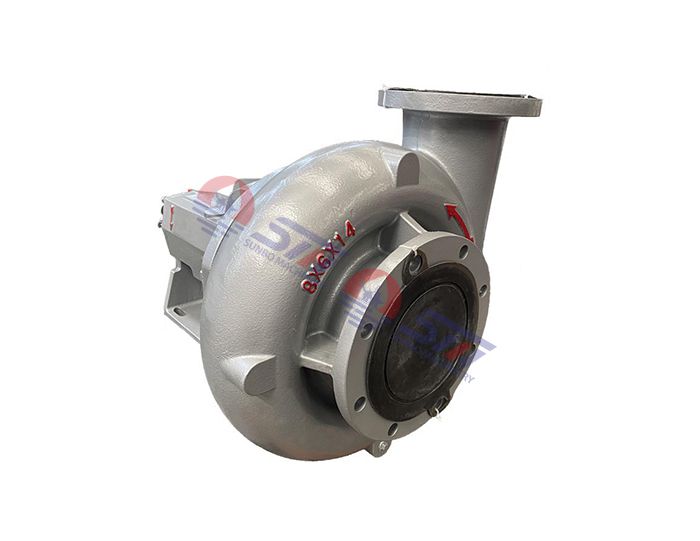
The current product specification published by Sunbo Machinery lists the SM 8x6x14 configuration with an 8-inch inlet, 6-inch outlet and an operating speed range of 1200–1800 RPM. The published comparison table also identifies maximum capacity and head figures for the pump family.
These figures help establish the general performance envelope, but a project should not be specified using maximum values alone.
A better selection process starts with the actual required flow, total dynamic head and fluid properties. Engineers can then determine which impeller and speed combination places that duty point in an appropriate part of the pump performance curve.
This approach is particularly important when the same pump is considered for very different applications.
A drilling mud circulation system, quarry slurry transfer line and industrial charge-pump service may all use a similar pump frame, yet their hydraulic requirements can be very different.
Water performance provides a useful baseline for centrifugal pump selection, but slurry applications introduce additional variables.
Drilling mud can contain weighting materials, drilled solids and chemical additives. Quarry or mineral slurry may contain highly abrasive particles with significant solids concentration. These properties influence both hydraulic performance and component life.
Density affects the power required by the pump. Higher-density fluids require more power at the same hydraulic condition.
Viscosity can reduce hydraulic efficiency and alter the relationship between flow and head.
Solids can increase wear on the impeller and casing, particularly when particle velocity becomes high.
Particle size and shape can also affect erosion patterns. Fine solids may behave differently from coarse, angular particles.
As a result, a pump that works well for one slurry should not automatically be assumed to be suitable for another merely because the required flow rate is similar.
Increasing pump speed may help produce more flow and head, but it can also increase the pump's suction requirement.
If sufficient pressure is not available at the pump inlet, vapor bubbles can form and collapse inside the pump. This phenomenon is known as cavitation.
Cavitation can cause noise, vibration, unstable performance and progressive erosion of hydraulic components.
Good pump selection therefore requires comparison between the net positive suction head available from the system and the suction requirement of the pump at the intended operating condition.
The available suction head is influenced by tank level, atmospheric pressure, fluid vapor pressure, suction pipe length, pipe diameter, fittings, strainers and fluid temperature.
A pump operating successfully at one speed may develop suction problems after speed is increased.
For detailed installation and operating considerations, see our Mission Magnum pump installation and maintenance guide.
Hydraulic selection determines whether a pump can deliver the required duty. Material selection determines whether its wetted components can survive the fluid.
For abrasive applications, wear resistance is normally a major concern. For corrosive liquids, chemical compatibility may be more important. In some systems, both erosion and corrosion occur at the same time.
Sunbo Machinery offers Mission-type pump configurations with different material options for different working environments, including hard iron, high-chrome and stainless-steel options depending on the application.
The appropriate material should be selected by considering slurry abrasiveness, pH, chemical composition, temperature, solids content and expected operating hours.
Choosing a more expensive material does not automatically produce the lowest operating cost. The goal should be to match the material to the actual failure mechanism.
A centrifugal slurry pump should not be selected only by checking its casing and impeller.
The sealing arrangement also has a significant influence on reliability.
Different services may require mechanical seals, packed stuffing-box arrangements or other sealing configurations. Selection depends on factors such as solids concentration, leakage tolerance, shaft speed, pressure, fluid properties and maintenance practices.
A pump may have sufficient hydraulic capacity but still become unreliable if the sealing arrangement is inappropriate for the medium.
This is especially important for abrasive fluids because solids can accelerate wear around the shaft and sealing surfaces.
When replacement components are required, the site's Mission Magnum centrifugal pump parts reference provides information on common casings, impellers, seals, shafts, bearings and related components.
Motor sizing should not be completed before the intended hydraulic operating point is understood.
Increasing pump speed or selecting a larger effective impeller can increase power demand. Higher-density slurry also requires more shaft power than water at the same hydraulic condition.
A motor that is too small may overload when operating conditions change. An excessively large motor may add unnecessary cost without correcting poor pump selection.
The drive should therefore be checked against the expected operating range rather than against a single theoretical point.
Where variable operating conditions are expected, sufficient margin should be considered while still keeping the pump within an efficient and mechanically reasonable range.
A useful pump enquiry contains more than a model number.
The following information allows an engineer or supplier to evaluate the operating condition more accurately:
| Selection Information | Why It Matters |
| Required flow rate | Defines the desired capacity |
| Total dynamic head | Defines the pressure requirement |
| Fluid or slurry type | Influences hydraulics and materials |
| Slurry density | Affects power requirement |
| Solids concentration | Influences wear and performance |
| Maximum particle size | Helps evaluate passage and wear |
| Fluid temperature | Affects material and seal selection |
| Suction conditions | Determines cavitation risk |
| Required pump speed | Influences flow, head and wear |
| Available motor power | Limits usable operating range |
| Preferred material | Helps match corrosion and abrasion conditions |
| Seal requirement | Affects leakage control and maintenance |
| Duty cycle | Helps evaluate component life |
| Existing pump model | Useful for replacement projects |
When these details are available, pump selection becomes an engineering comparison rather than a simple model match.
Replacement projects often begin with the inlet and outlet dimensions of an existing pump.
Connection size is important because it affects piping compatibility, but it should not be the only selection criterion.
If operating conditions have changed since the original installation, replacing the existing pump with an identical nominal size may repeat an existing performance problem.
Changes such as higher production rates, increased slurry density, longer pipelines, new process equipment or different fluid composition can alter the required duty.
Before ordering a replacement pump, it is therefore worth confirming whether the original operating point is still valid.
This is particularly useful when a plant is experiencing repeated wear, insufficient flow, excessive vibration or motor overload.
No.
Higher speed can increase hydraulic output, but it also increases velocity through the pump.
For abrasive media, increased particle velocity can accelerate erosion. Higher speed can also increase bearing loads, sealing demands, power consumption and suction requirements.
The most suitable operating speed is therefore the speed that achieves the required duty while keeping the pump within an acceptable hydraulic and mechanical operating region.
For abrasive service, lower-speed operation with an appropriately selected pump and impeller may sometimes provide better lifecycle performance than forcing a smaller pump to operate at a very high speed.
The final choice should depend on the required duty and verified performance data.
An 8x6x14 configuration may be considered when the process requires relatively high flow and the system conditions fall within the pump's available performance range.
Typical applications can include drilling-fluid circulation, sand slurry handling, quarry slurry, mining processes, industrial transfer duties and other services involving abrasive or solids-containing liquids.
However, the designation itself should not be used as proof that the pump is suitable.
A smaller Mission Magnum configuration may be more appropriate for a lower-flow duty. A larger configuration may be required when capacity, suction conditions or system requirements exceed the practical range of the 8x6x14.
The objective is not to choose the largest pump available. It is to choose the pump whose hydraulic range best matches the system.
Increasing rotational speed generally increases centrifugal pump flow, head and power requirement, but the actual operating flow is determined by the interaction between the pump curve and the system curve. Slurry properties and suction conditions can also affect actual performance.
The same basic pump size may be considered for both applications, but material, seal configuration, drive arrangement and operating point may need to change. The slurry characteristics should be evaluated before final selection.
Required flow, total dynamic head, pump speed, fluid density, solids concentration, suction conditions and motor power are among the main factors. The final impeller selection should be checked against the applicable pump performance curve.
Actual flow depends on system resistance. Long pipelines, small pipe diameters, valves, fittings, elevation changes, suction restrictions and slurry properties can all reduce the operating flow compared with a simplified expectation.
Maximum capacity should be treated as a performance boundary rather than an automatic design point. A pump should normally be selected around the actual required operating condition and checked for efficiency, power, suction performance and mechanical reliability.
Impeller diameter and operating speed have a major influence on Mission Magnum pump performance, but neither should be selected independently. The correct configuration depends on the complete system: required flow, head, slurry characteristics, suction conditions, drive power, materials, sealing requirements and expected operating environment.
For an 8x6x14 or another Mission-type centrifugal pump, the most reliable approach is to define the operating condition first and then select the pump, impeller, speed, material and drive arrangement around that requirement. Sunbo Machinery can evaluate pump requirements for drilling mud, abrasive slurry, sand, mining and industrial fluid-handling applications based on your actual flow, head, medium and operating conditions.



Copy Right: Sunbo Machinery | Sitemap
Disclaimer: We don't represent or is not in anyway affiliated with Warman®, Metso®, Goulds®, Durco®, Andritz®, Mission® and other brand names, all these brand names are respected of their owners. Any brand name, model, number, symbols or any descriptions are used for reference purpose only, and do not imply that any part or pump listed is the product of Warman® , Metso®, Goulds®, Durco®,Andritz®, and Mission®. Our pump and spare parts interchangeable only.


